
Categories
7FA
Borescope
Gas Turbine Inspection
Non Destructive Testing
Secure Multi Party Computation
The Compiler
Uncategorized
Book Your
Consultation
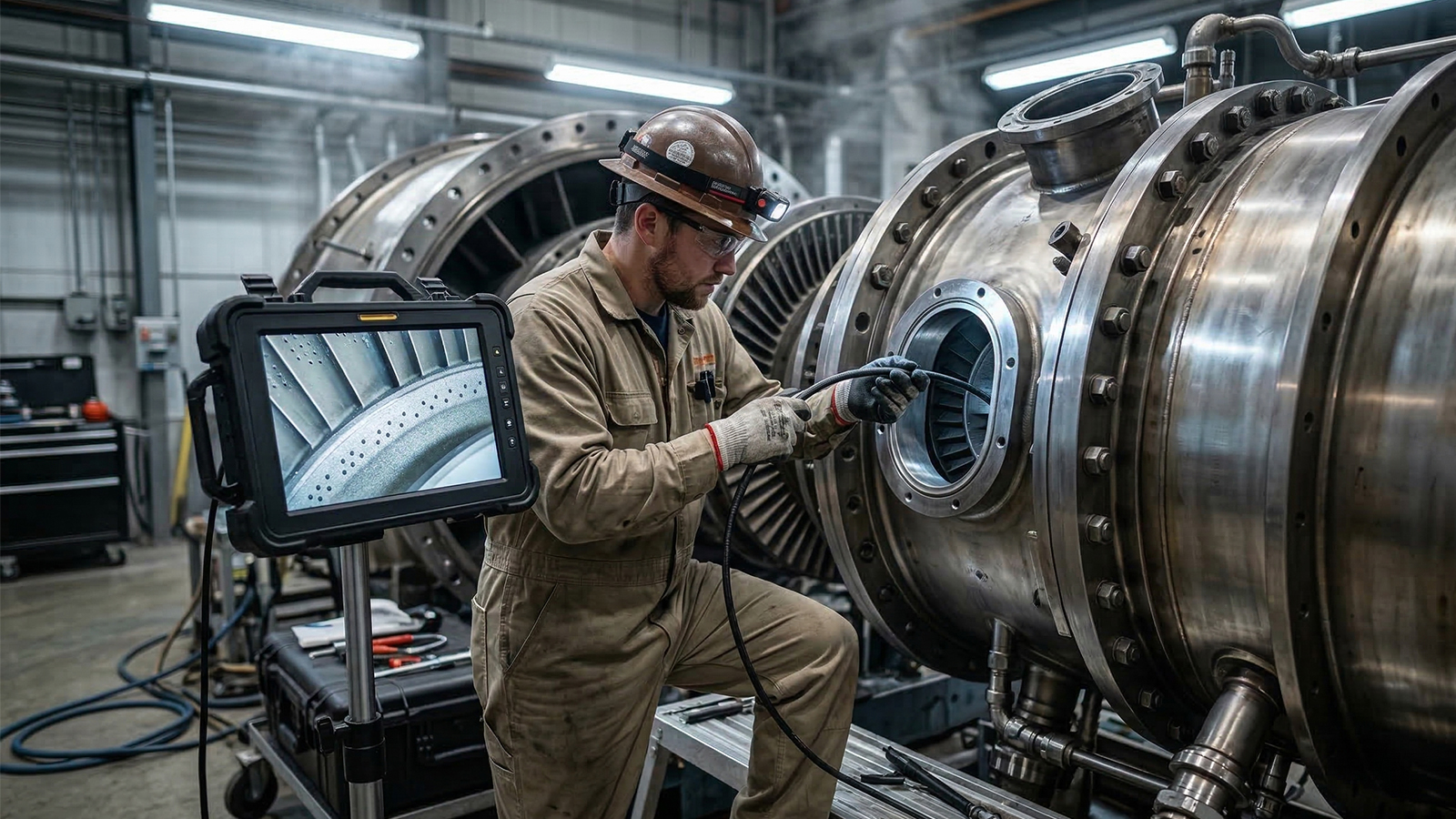
Every hour a turbine sits offline costs money. Whether you are managing a scheduled outage window or responding to a forced derate, the decisions made during that downtime determine what your unit looks like when it comes back online — and how long it stays available before the next unplanned stop. Borescope inspection is one of the most operationally leveraged tools available during planned windows: it gives your team a direct, documented look at the unit’s internal condition, and it produces actionable findings that drive every repair decision that follows.
KEY TAKEAWAYS
- Borescope inspection allows technicians to inspect turbine blades, the combustion section, and upstream stages — giving your team the data needed to identify issues before they escalate into forced shutdowns.
- Warning signs including base metal cracking, thermal barrier degradation, and wear accumulation are detectable during planned intervals before they result in forced shutdowns.
- A data-driven maintenance approach depends on borescope inspection data to set appropriate repair scope and maintenance schedules.
- Regular borescope inspections significantly reduce the risk of unexpected failures and unplanned downtime events.
- Gas and steam turbines across power generation, industrial, and petrochemical applications benefit from incorporating borescope inspections into every maintenance cycle.
- Advanced Turbine Support delivers documented inspection reports within 24 hours, giving operators and engineers the data needed to act decisively.
THE IMPACT OF SKIPPING A BORESCOPE INSPECTION ON YOUR OUTAGE BUDGET
What Undetected Blade Damage Actually Costs
Turbine blades in Stage 1 of the Hot Gas Path operate under inlet temperatures that can exceed 2,400°F and centrifugal stresses that push thermal barrier coatings to their design limits every operating cycle. When coating loss, oxidation, or tip rub goes undetected through routine inspections, it does not disappear — it progresses. By the next interval, what was a repairable blade surface finding may have developed into through-wall cracking or base metal exposure that requires full component replacement.
The difference in repair cost between early-stage blade blending within OEM limits and a Stage 1 bucket replacement is significant — replacement parts, extended downtime, and expedited logistics can push an event well beyond its planned budget. For blade assemblies approaching their recommended service interval, even minor surface degradation that would have been addressable through in-situ blending can require full removal when left unmonitored. Left unaddressed across multiple intervals, base metal cracking and damage can progress to catastrophic failure of Stage 1 hardware — an outcome that dwarfs any inspection cost.
The Operational Case for Early Detection
An undetected defect does not stay bounded. Deposit buildup on combustion hardware restricts airflow, alters temperature distribution, and drives exhaust temperature spreads that erode both performance and reliability. Vibration anomalies that surface between scheduled intervals often trace back to imbalance conditions that a skilled inspector would have flagged during a previous borescope inspection.
Operators who fail to detect early-stage degradation through regular inspections are not saving money. They are deferring risk until it is no longer manageable within a planned window.
HOW BORESCOPE INSPECTION ALLOWS YOU TO VISUALIZE CRITICAL TURBINE COMPONENTS
Inspect Internal Components Without Disassembly
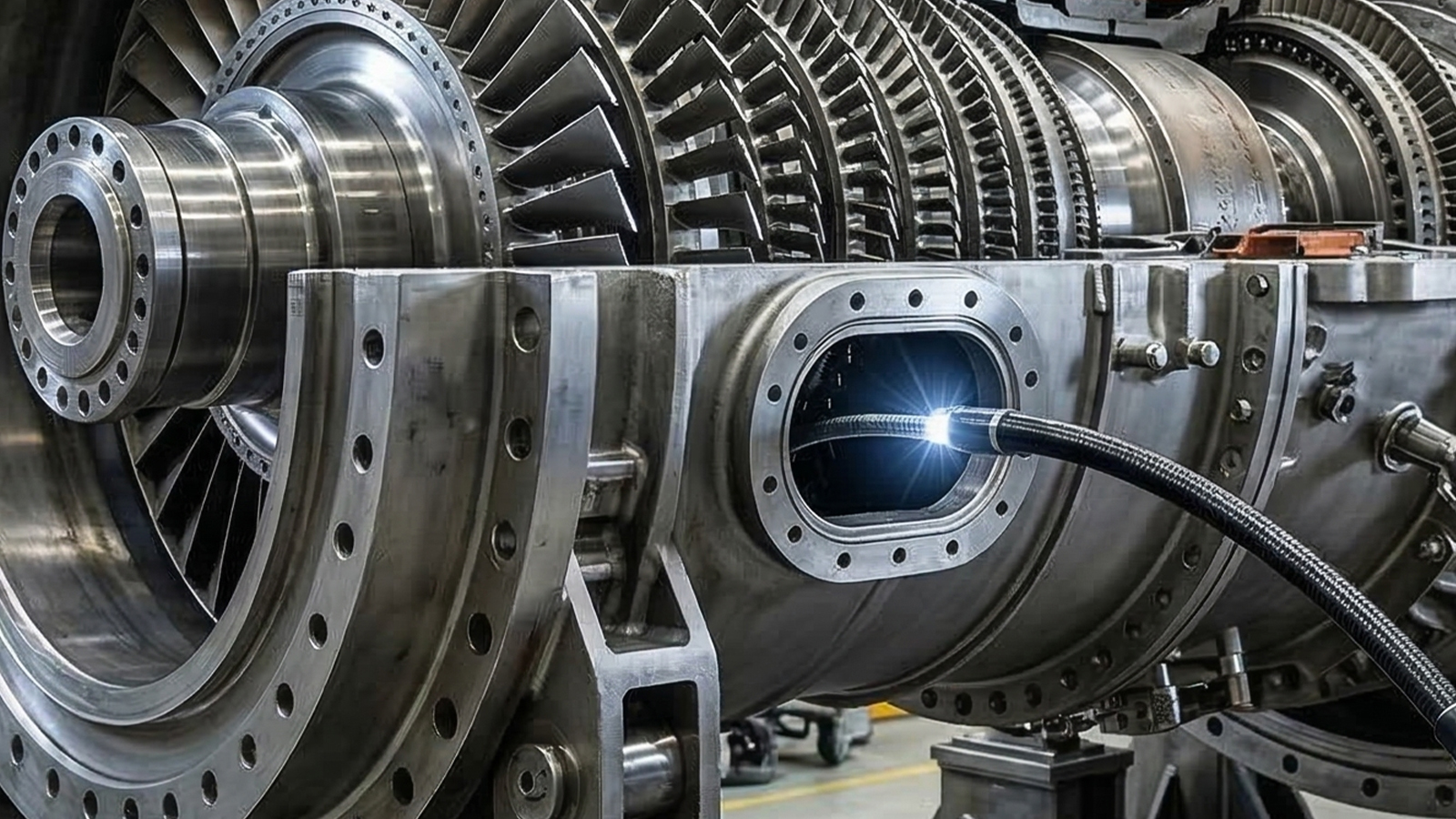
A borescope inspection involves inserting a flexible optical instrument equipped with a high-resolution camera and integrated light source through designated access points in the turbine casing. Using a borescope, a technician can assess key components across multiple stages — turbine blades, Transition Pieces, the compressor, and the rotor — while preserving the integrity of seals and fasteners. This non-destructive approach also supports troubleshooting by allowing maintenance teams to access internal conditions that no external sensor can reliably capture.
Video borescopes deliver real-time, high-quality imaging that allows the inspector to document findings systematically, building a photographic record that supports engineering review and OEM comparison against service limits. The inspection allows the team to identify pit formation, cooling hole blockage, and thermal distress indicators across blade surfaces with a precision that external monitoring cannot provide.
What Borescopes Reveal Across Turbine Sections
A thorough visual inspection covers the Hot Gas Path for base metal distress and thermal fatigue indicators, the combustion section for cracking and scale accumulation, and the rotor and stationary hardware for signs of wear and mechanical contact. Borescopes with articulating probe tips allow the technician to reach inspection planes previously inaccessible without partial teardown. This documentation serves as a condition record that can be trended across multiple inspection intervals to identify platform-specific degradation rates.
Originally developed for aircraft engines, these instruments have evolved into proprietary inspection platforms capable of imaging narrow radial gaps and producing dimensional data alongside visual findings. A skilled inspector identifies not just surface anomalies on critical components — but the underlying failure mode that drives the appropriate repair disposition.
EARLY WARNING SIGNS THAT CONDITION-BASED TURBINE MAINTENANCE DEPENDS ON
Hot Gas Path and Blade Findings
Routine wear and tear on Stage 1 and Stage 2 buckets accelerates under high thermal load, making visual documentation at every planned interval the only reliable way to track degradation rate. Condition based turbine maintenance depends on identifying: crack initiation at leading and trailing edges under combined thermal and mechanical fatigue, erosion of blade tip platforms, and discoloration patterns that indicate cooling circuit degradation. Each of these findings has a specific disposition — blend, monitor, or replace — that the borescope inspection report documents for engineering review.
Identifying these conditions during a planned outage, rather than discovering them after a forced derate, is the operational value borescope inspection delivers. Acting on these findings enables a targeted repair that costs a fraction of what an unplanned event would demand.
Upstream Stage and Airflow Indicators
The front stages are frequently the source of performance degradation that plant operators notice through heat rate increases or output loss before any turbine inspection confirms the source. Inspection of these stages reveals blade corrosion, scale accumulation on leading edges, and surface degradation that reduces airflow efficiency — findings that directly inform wash scheduling and maintenance decisions.
For gas turbines operating in coastal or industrial environments, wear accumulation and surface degradation on upstream blades between planned intervals can be significant. Visual examination of the R0 and S0–S4 stages gives your maintenance team the baseline data to make informed interval adjustments. Consistent inspection data from the front stages also supports proactive wash scheduling, helping operators maintain optimal heat rate and output between major inspections.
HOW FINDINGS DRIVE MAINTENANCE DECISIONS AND MINIMIZE DOWNTIME
Proactive Mitigation vs. Unplanned Scope Expansion
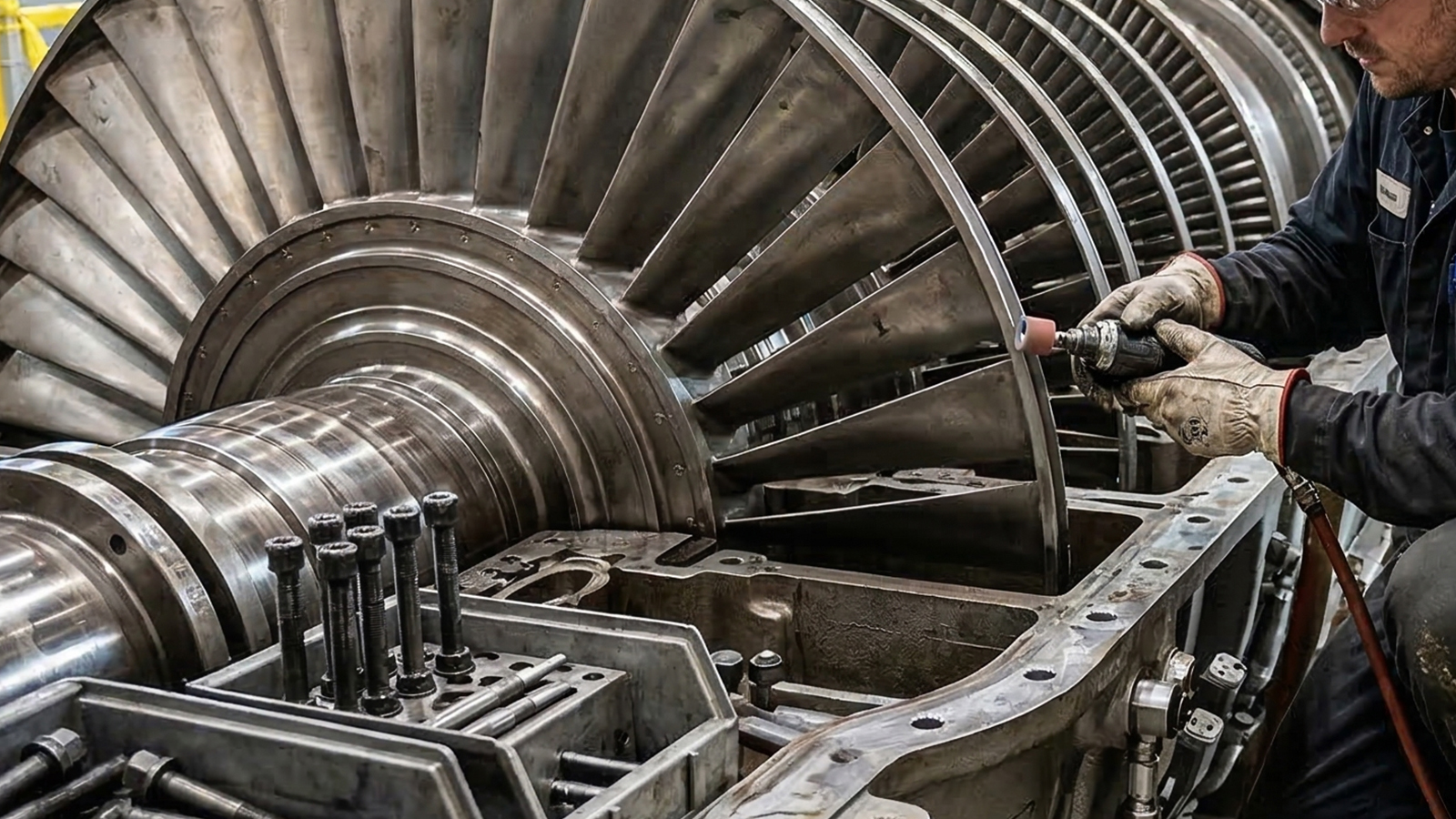
Building a documented condition baseline through regular borescope inspection gives your engineering team the foundation for proactive mitigation. When an inspector identifies a crack on a Stage 2 blade that remains within OEM blend limits, that finding can be addressed in-situ through blade blending — restoring structural integrity without part replacement. Without this data, that crack progresses unmonitored and could lead to component liberation during the next operating cycle.
The alternative is reactive: an unplanned event triggers emergency parts logistics and introduces scope expansion that was never budgeted. Inspections significantly reduce this risk by putting condition data in front of the people who control the repair decision — before it becomes a crisis.
Scheduling Borescope Inspections Across Your Maintenance Cycle
Regular borescope inspections — conducted at every planned interval, and triggered between windows when performance data indicates an efficiency drop exceeding 2% or exhaust temperature spreads over 20°F — form the foundation of a structured maintenance strategy. These schedules allow operators to extend intervals where hardware condition supports it, or tighten them when risk indicators emerge.
A steam turbine inspection protocol and a gas turbine borescope inspection program both depend on the same principle: documented, repeatable visual inspection performed by experienced technicians who understand the failure modes of each platform. The longevity of your assets depends on inspections that are regular, structured, and performed by qualified personnel. Advanced Turbine Support provides these services across GE Frame, Siemens-Westinghouse, and aeroderivative platforms — with bilingual inspectors available worldwide.
SAFEGUARD YOUR TURBINE — CLOSING SUMMARY
Borescope inspection is not a check-the-box activity. It is the primary mechanism through which maintenance teams identify degradation, validate hardware condition, and produce inspection data that supports every downstream repair and scheduling decision. For operators of gas and steam turbines in power generation and industrial applications, regular inspections directly impact availability, outage budget, and long-term asset reliability.
Ensuring the reliability of your turbine starts with knowing what is happening inside it. A borescope inspection gives your team the ability to move from assumption to documented condition — reducing the risk of unexpected failures and giving your engineering team the information needed to mitigate costly scope expansion before it occurs.
Advanced Turbine Support delivers borescope inspection services for a full range of turbine models with inspection reports within 24 hours. Our inspectors combine field experience with advanced borescopes and professional-grade video systems to ensure no finding goes undocumented. Contact Advanced Turbine Support today to schedule your inspection and protect both your unit and your outage budget.
Frequently Asked Questions
How does a borescope inspection allow technicians to visualize internal gas turbine components?
A borescope inspection involves inserting a high-resolution optical instrument through designated access points to visually assess the combustion section, turbine blades, compressor stages, and rotor without disassembly. Advanced Turbine Support delivers documented findings within 24 hours of inspection completion.
How do borescope inspections support a condition based turbine maintenance schedule?
Borescope inspections should be scheduled at every planned outage, with additional triggered inspections when compressor efficiency drops exceed 2% or exhaust temperature spreads exceed 20°F. Condition-based maintenance schedules built around consistent inspection data allow operators to adjust intervals based on actual hardware findings.
What early warning signs does a borescope inspection detect, and what is their impact on repair scope?
Borescope inspections detect coating loss, base metal cracking, erosion, deposit buildup, discoloration, and cooling hole blockage across the Hot Gas Path and compressor stages. Identifying these findings during a planned outage prevents progression to conditions that require full component replacement.
Can borescope inspections minimize downtime by inspecting turbine components without disassembly?
Borescope inspections allow technicians to inspect internal turbine components without disassembly by accessing the unit through pre-existing ports in the casing. This non-destructive approach preserves seal and fastener integrity while keeping the outage window within schedule.
What turbine platforms does Advanced Turbine Support inspect?
Advanced Turbine Support provides borescope inspection services for a full range of gas and steam turbine platforms, including GE Frame 5, 6B, 7EA, and 7FA units, Siemens-Westinghouse 501 series, other OEM 501F/G/J, and aeroderivative models including the LM6000 and Pratt & Whitney FT-8. Bilingual inspectors are available for deployment 24/7 worldwide.
Next Posts
Pre-Outage Borescope Inspection: How to Define Repair Scope Before the Turbine Comes Apart
admin September 25, 2026
OEM vs. Independent Borescope Inspection Providers: What Plant Managers Should Compare
admin September 11, 2026
GE 7EA Compressor Borescope Inspection: Common Failure Modes, TILs & What Operators Should Look For
admin August 28, 2026